
Connecticut Orthopaedics Performs First Thumb Joint Replacement Using New KeriMedical TOUCH® CMC 1 Implant
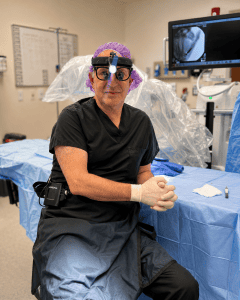
Connecticut Orthopaedics is proud to announce that Richard Bernstein, MD, a hand and wrist specialist, has performed the practice’s first surgery using the KeriMedical TOUCH® CMC 1 Thumb Prosthesis at Connecticut Orthopaedic Surgery Center in Milford.
The procedure offers a new option for some patients living with painful arthritis at the base of the thumb. This type of arthritis can make everyday tasks—such as opening jars, turning keys, gripping objects or pinching with the thumb—difficult and painful.
The TOUCH® CMC 1 Prosthesis is a thumb joint replacement designed to replace the damaged joint at the base of the thumb. The implant is cementless and uses a ball-and-socket design, similar in concept to other joint replacements such as hip or shoulder replacements. The device received FDA premarket approval for use in patients with certain stages of symptomatic thumb base arthritis.
Dr. Bernstein recently returned from France, where he completed specialized training in this innovative surgical technique as part of a small group of U.S. surgeons learning to perform the procedure.
“Thumb arthritis can be incredibly frustrating because it affects so many simple daily activities,” said Dr. Bernstein. “This implant allows us to replace the worn-out joint rather than remove the entire bone and reconstruct the area with a tendon. For the right patient, our goal is to help reduce pain, improve function and allow for an earlier start to rehabilitation.”
For many years, a common surgical treatment for advanced thumb arthritis involved removing the trapezium bone at the base of the thumb and using a tendon from the forearm to stabilize the area. While that approach has helped many patients, recovery can take time and may include several weeks of casting followed by splinting and therapy.
The TOUCH® CMC 1 implant is designed to preserve bone and provide stability through a joint replacement approach. Because of that stability, appropriate patients may be able to begin therapy sooner than with traditional procedures. As with any surgery, results and recovery times vary by patient.
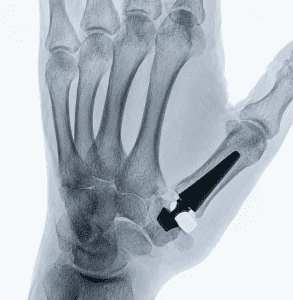
The implant has been used in Europe for several years and is now being introduced in the United States following FDA approval. A U.S. post-approval study is also underway to continue evaluating safety and effectiveness in American patients.
“European hand surgeons have seen encouraging results with this technology, and we are excited to bring this option to patients here in Connecticut,” Dr. Bernstein said. “It represents an important advancement in how we can treat thumb arthritis while helping patients get back to the activities they enjoy.”
Patients experiencing persistent pain, weakness or loss of motion at the base of the thumb should speak with a hand and wrist specialist to determine which treatment options may be appropriate for them.
To learn more about thumb arthritis treatment options or to find out whether this procedure may be right for you, schedule a consultation with Dr. Richard Bernstein at Connecticut Orthopaedics.